By Morocco Desert Guide | Last updated: 2026
Spending a night in a desert camp near Merzouga is the centrepiece of any Morocco Sahara experience. But not all camps are the same and since the Moroccan authorities relocated unlicensed camps in 2019, the landscape of where camps are located, how to reach them, and what to expect has changed significantly.
This guide covers everything you need to know: the types of camps available, real price ranges, how camps have changed since 2019, and how to choose an ethical, quality operator. As a licensed Moroccan tour operator based in Marrakech with years of firsthand experience guiding travellers into Erg Chebbi, this is the honest local picture not a marketing brochure.
What Happened to Desert Camps in Merzouga in 2019?
In 2019, Moroccan local authorities closed dozens of unlicensed desert camps operating directly within the Erg Chebbi dunes. The reasons were environmental: unregulated waste disposal, untreated sewage, and unsustainable water usage were damaging the fragile desert ecosystem. The closures sparked debate among local communities, since desert tourism is the economic backbone of the Merzouga region.
The result is that today, licensed desert camps are no longer positioned directly at the foot of the dunes. They operate in the desert surrounding Erg Chebbi still a genuine wilderness experience, still under open Saharan skies but set back from the most photographed dune faces.
What this means for travellers:
- You now reach most camps by camel (40–60 minutes ride) or by 4×4 vehicle (10–20 minutes)
- The camel ride to the camp is included in most packages and is part of the experience
- Camps that claim to be “inside the dunes” or “at the base of the dunes” should be questioned carefully ask whether they are licensed and registered
This is not a downgrade to the experience. In many ways, the relocation pushed camps further into genuine desert silence, away from the cluster of hotels along the Merzouga dune edge.
Types of Desert Camps in Erg Chebbi
1. Basic Berber Camp
The most traditional option. Basic Berber camps offer a direct, unfiltered desert experience with minimal modern comforts.
What you get:
- Shared toilet facilities (outside the tent area)
- Simple Berber-style tent with blankets and thin mattress
- Traditional dinner: vegetable tagine, bread baked on coals, mint tea
- Evening music around the fire usually a small drum circle with the camp guides
- Breakfast: bread, olive oil, jam, mint tea
Price range: 300 to 500 MAD per person (approximately €28–46 / $30–50)
Best for: Budget travellers, backpackers, those who prioritise authenticity over comfort
Honest note: Temperatures in the desert drop significantly at night, even in summer. Basic camps provide blankets but bring a warm layer regardless. Shared toilet facilities are basic managed expectations matter here.
2. Standard Camp
The most common option for travellers booking 3-day Morocco desert tours. Standard camps offer private tents with a step up in comfort while maintaining an authentic desert atmosphere.
What you get:
- Private Berber-style tent per couple or small group
- Shared toilet block with flush toilets
- Proper mattresses with clean linens
- Three-course dinner: salad, tagine, dessert, unlimited mint tea
- Evening entertainment: Berber drums, occasionally Gnawa music
- Breakfast included
Price range: 600–900 MAD per person (approximately €55–83 / $60–90)
Best for: Couples, families, most independent travellers, those on organised Morocco tours
Honest note: Standard camps vary considerably in quality. The key difference is food quality and tent maintenance. When booking through a tour operator, always ask how long they have worked with a specific camp and whether they have visited it personally.
3. Luxury Camp
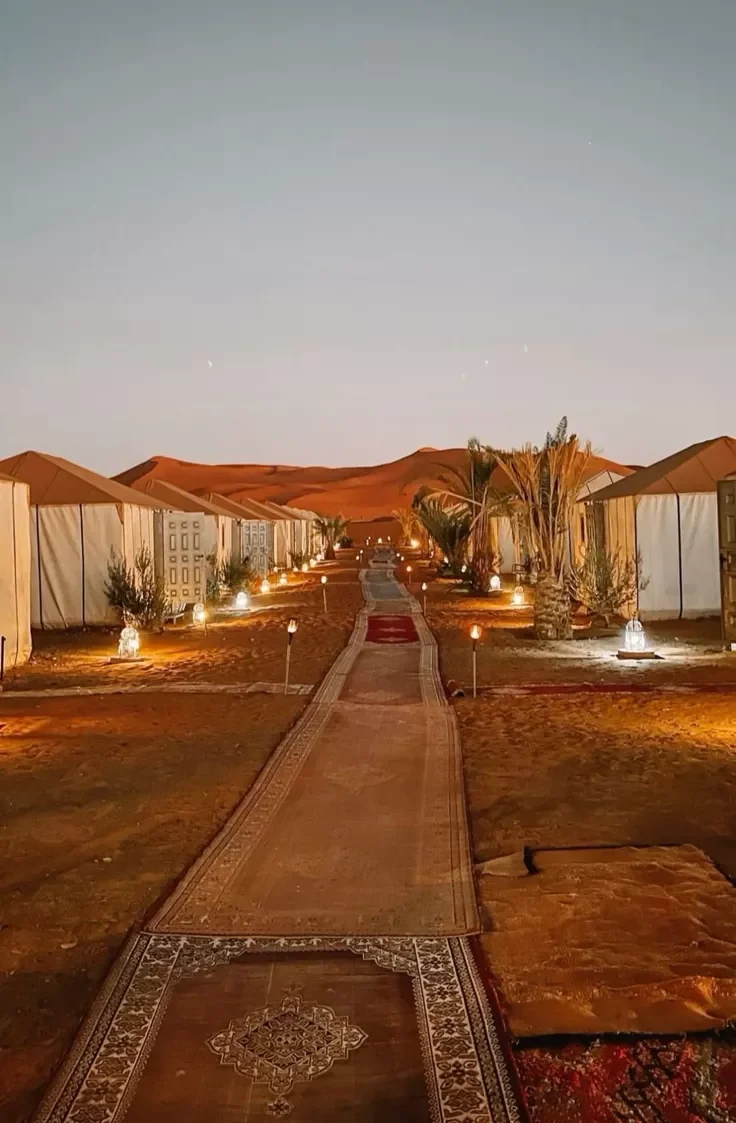
Luxury desert camps have grown significantly in number since 2019 and now represent a proper alternative to boutique hotel accommodation with the added dimension of sleeping in the Sahara.
What you get:
- Large ensuite private tent with proper double bed and high-quality linens
- Private bathroom with hot shower and western-style toilet
- Air conditioning or climate control (available in most luxury camps)
- Gourmet dinner: multi-course meal combining Moroccan and international flavours, often served under the stars on a carpet with lanterns
- Evening entertainment: professional musicians, sometimes fire performers
- Private terrace with panoramic dune views
- Swimming pool available at some luxury camps (filled from hotel facilities before you arrive at camp)
Price range: 1,500–3,000 MAD per person (approximately €138–277 / $150–300)
Best for: Couples celebrating anniversaries or honeymoons, those who want the Sahara experience without sacrificing sleep quality, families with young children who need proper toilet facilities
Honest note: The word “luxury” is used loosely by some operators. A genuine luxury camp will have an ensuite bathroom inside the tent structure not a shared block 50 metres away. Always confirm this before booking.
4. Glamping / Boutique Camp
The newest category, and the fastest-growing. Boutique glamping camps in Erg Chebbi are fully designed experiences architecturally styled tents, curated menus, creative lighting, and personalised service.
What you get:
- Architecturally designed tent or geodesic dome structure
- Luxury bedding, rugs, and décor inspired by Berber and Tuareg aesthetics
- Fine dining in the desert: think local lamb, preserved lemon, hand-ground spices
- Personalised service: a dedicated camp attendant
- Stargazing sessions with a guide explaining Saharan constellations
Price range: 3,000–6,000 MAD per person (approximately €277–554 / $300–600)
Best for: Luxury travellers, special occasions, photographers, those for whom the camp itself is the destination
What a Night in a Desert Camp Actually Looks Like
Understanding the timeline of a desert camp night helps set accurate expectations.
Afternoon: Departure from Merzouga
Most camps begin the camel trek from the edge of Merzouga village at around 5:00–6:00 PM. This timing is deliberate: it allows travellers to ride through the dunes as the light changes for sunset, then arrive at camp after dark.
Your camel guide will lead the caravan. Camels walk at approximately 4–5 km/h in sand. The journey to camp takes 40–60 minutes depending on the camp’s location. Stops are made at high dune points to photograph the sunset.
Evening: Arrival at Camp
On arrival, you are shown to your tent and given time to wash and settle. In most camps, a welcome drink of spiced Moroccan tea and dates is served.
Dinner is served at around 8:00–9:00 PM, either inside a communal dining tent or around a central fire area. The standard meal structure is: salad plate, harira soup (in cooler months), main tagine, fresh fruit, mint tea.
After dinner, the evening music begins. Berber camp guides typically play bendir drums and sing traditional songs of the Sahara a mix of Berber, Gnawa, and Tuareg influences. Guests are welcomed to join. The atmosphere is informal and warm.
Night: Sleeping in the Desert
The desert is genuinely quiet at night. There is no traffic, no urban light pollution, and on cloudless nights which are the majoritythe Milky Way is fully visible from the camp. Many travellers describe this as one of the most memorable nights of their lives.
Temperature drops sharply after sunset. In October and April (peak season), nighttime temperatures in Erg Chebbi range from 5°C to 15°C. Even in summer, temperatures can drop to 20°C at night. All camps provide blankets; luxury camps provide duvets. Bring a warm layer regardless.
Morning: Sunrise
Camp guides wake travellers approximately 45 minutes before sunrise usually between 5:30–6:30 AM depending on the season. The short walk or camel ride to a high dune position for sunrise is the highlight of most travellers’ desert experience.
The light in the Sahara at sunrise moves through orange, pink, gold, and white over approximately 25 minutes. The direction of Erg Chebbi means the best sunrise views face east toward the Algeria border the dunes cast long shadows behind you into the camp.
Breakfast is served after sunrise: bread, oil, jam, honey, eggs in most standard and luxury camps.
Return to Merzouga is by camel (same route, 40–60 minutes) or 4×4 vehicle (10–20 minutes). Most tours use camel out and 4×4 return.
How to Choose the Right Desert Camp
Questions to Ask Before Booking
1. Is the camp licensed? Since the 2019 closures, all operating camps should hold a licence from the Errachidia Provincial authorities. Ask your operator directly. If they cannot confirm, that is a red flag.
2. Does the ensuite tent have a bathroom inside the tent structure? If booking luxury, this is the single most important question. “Private bathroom” can mean a shared block that is technically reserved for your tent not the same thing.
3. How far is the camp from the dunes? Camps vary from 2 km to 8 km from the main Erg Chebbi dune face. Further is not necessarily worse it means more silence and more stars. But if watching the dunes from your tent terrace is important to you, confirm the distance.
4. What is included in the price? Confirm: camel ride, dinner, breakfast, return transport. Many budget camps charge separately for the camel ride (add 150–200 MAD per person).
5. What is the camp’s waste management system? A responsible camp operator will be able to answer this. Bins, removal schedule, and no open burning are baseline standards.
Environmental Responsibility at Desert Camps
The Erg Chebbi dunes are a fragile ecosystem. The 2019 camp closures were a direct response to visible environmental damage caused by unregulated tourism. As a traveller, there are straightforward steps you can take:
- Take all rubbish back to Merzouga. Do not leave anything in the dunes, including organic waste.
- Use water carefully. The Merzouga region has limited groundwater. Luxury camps that offer showers are using water transported from the village — use it mindfully.
- Do not pick up rocks, fossils, or plant material from the desert. The area around Merzouga and Erfoud is rich in fossils — removal is illegal under Moroccan law.
- Choose licensed camps. Unlicensed operators exist. They are cheaper. They also typically have no waste management system and no accountability. The 150 MAD you save does not justify the environmental cost.
- Respect the camels. Ask your operator about their camel welfare standards. Camels should have access to food, water, and rest between treks. Operators who run multiple camel trips per day without adequate rest periods should be avoided.
Practical Information
Best Time of Year to Visit
| Season | Months | Night Temperature | Notes |
|---|---|---|---|
| Peak season | Oct–Nov, Mar–Apr | 8–15°C | Best weather, book in advance |
| Winter | Dec–Feb | 2–8°C | Cold nights, fewer crowds, bring warm clothing |
| Spring | Mar–May | 12–18°C | Ideal — warm days, cool nights |
| Summer | Jun–Sep | 20–25°C | Extremely hot days (45°C+), not recommended |
How Far is Merzouga from Marrakech?
Merzouga is approximately 560 km from Marrakech a 9–10 hour drive. Most travellers combine the journey with a 3-day Morocco desert tour that includes stops at Ait Ben Haddou, the Dades Gorge, and the Draa Valley on the way out, and a different route on return. This is the standard format for organised Morocco desert tours from Marrakech.
What to Bring to a Desert Camp
- Warm jacket or fleece (essential even in summer)
- Scarf/shesh to wrap around your face in case of sand wind
- Sunscreen and sunglasses for the morning dune walk
- Camera or phone with good low-light performance for stars
- Cash in MAD for tips (50–100 MAD per guide is standard)
- Personal medication — the nearest pharmacy is in Rissani, 42 km away
- Earplugs if you are a light sleeper (wind and animal sounds are common)
Price Summary
| Camp Type | Price per Person (MAD) | Price per Person (EUR approx.) |
|---|---|---|
| Basic Berber | 300–500 | €28–46 |
| Standard | 600–900 | €55–83 |
| Luxury | 1,500–3,000 | €138–277 |
| Glamping / Boutique | 3,000–6,000 | €277–554 |
Prices include camel trek, dinner, and breakfast unless stated otherwise. Prices vary by season and group size.
Booking Your Desert Camp
Desert camps can be booked directly, through Merzouga hotels, or as part of an organised Morocco desert tour from Marrakech.
Booking direct gives you the best price but requires research to verify camp quality and licensing. Contact the camp by WhatsApp (the standard communication method in the region) and ask the questions listed above.
Booking through a Marrakech tour operator means your camp is vetted and your full journey transport, accommodation en route, desert camp, and return is handled by a single point of contact. For first time visitors to Morocco, this is the most straightforward option.
Booking through GetYourGuide or Viator adds a significant commission layer but provides traveller protection and English-language customer service if problems arise.
At Morocco Desert Guide, we work exclusively with licensed, vetted camps and include the desert camp night in all our Merzouga tour packages. Our team has personally stayed at every camp we recommend.
Frequently Asked Questions
Is it safe to sleep in a desert camp? Yes. Desert camps in the Merzouga area are well-established and safe for solo travellers, couples, and families. The main risks are environmental heat, dehydration, and cold at night all of which are manageable with basic preparation.
Can I visit a desert camp without a camel ride? Yes. A 4×4 transfer to camp is available at most operators, usually at no additional cost. This is the better option for elderly travellers, those with back problems, or young children.
Are desert camps suitable for children? Yes, with preparation. Children tend to love the camel ride and the campfire. Ensure your camp has proper toilet facilities and that you bring warm clothing for children at night. Standard and luxury camps are better suited for families than basic Berber camps.
Do camps have electricity? Most standard and luxury camps have solar-powered lighting. USB charging points are available in most luxury camps. Basic camps typically have no electricity bring a torch.
Is wifi available in the desert? No. You are in the Sahara. Moroccan SIM cards (Orange or Maroc Telecom) have limited signal 2–3 km from Merzouga village. Embrace the disconnect this is part of the experience.
Morocco Desert Guide is a licensed Moroccan tour operator based in Marrakech. We run private and shared desert tours from Marrakech to Merzouga and Erg Chebbi. Contact us at moroccodesertguide1@gmail.com or +212669565458.
For more information on Morocco desert experiences, visit morocco-desert-guide.com.


