
By Abdellatif Mansour Morocco Desert Guide | Updated 2026
A Morocco camel trek is one of the most iconic travel experiences on earth. Riding a camel into the Sahara Desert at sunset, watching the golden light fade over 150 metre dunes, spending the night under a billion stars with no light pollution for hundreds of kilometres this is the experience that brings hundreds of thousands of international travellers to Morocco every year.
I was born and raised in Marrakech. I have been guiding international travellers on camel treks through the Sahara Desert and Erg Chebbi dunes for years. This guide gives you everything you need to know before booking your Morocco camel trek real prices, honest expectations, and the insider advice that most travel blogs do not share.
What is a Morocco Camel Trek?
A Morocco camel trek is a guided journey on camelback through the Sahara Desert typically departing from the village of Merzouga at the edge of the Erg Chebbi dunes in southeastern Morocco. The trek takes you through rolling sand dunes to a desert camp where you spend the night under the stars before returning by camel or 4×4 the following morning.
The experience combines several extraordinary elements the physical sensation of riding a camel through the desert at sunset, the silence and scale of the Sahara, traditional Berber hospitality at the desert camp, music around the campfire, and the unmatched night sky of the Sahara Desert.
A Morocco camel trek is genuinely different from a camel ride at a tourist attraction. You are moving through a real desert, guided by experienced Berber camel handlers, in one of the most remote and spectacular landscapes on earth.
Where to Do a Morocco Camel Trek ?
Morocco has two main desert destinations for camel trekking. Understanding the difference helps you choose the right experience.
Erg Chebbi near Merzouga the Most Popular:
Erg Chebbi near Merzouga is the most popular and most spectacular destination for a Morocco camel trek. The dunes at Erg Chebbi rise to 150 metres above the surrounding desert and span approximately 28 kilometres from north to south. The scale and drama of Erg Chebbi dunes is genuinely extraordinary these are real Saharan dunes of the kind most people only see in photographs.
Merzouga village is approximately 560 kilometres from Marrakech and 480 kilometres from Fes a journey of 9 to 10 hours by road. Most travellers reach Merzouga as part of an organised 3 or 4 day desert tour from Marrakech or Fes.
Erg Chigaga near M’Hamid. More Remote:
Erg Chigaga near M’Hamid el Ghizlane is the other major camel trekking destination in Morocco. The dunes are further from the main tourist routes approximately 600 kilometres from Marrakech and significantly less visited than Erg Chebbi. Travellers who want to avoid the more commercialised experience of Erg Chebbi often prefer Erg Chigaga for its isolation and authenticity.
The journey to Erg Chigaga requires a 4×4 vehicle for the final stretch and the experience is more genuinely remote. Desert camps here are fewer and simpler. The camel trek experience is similar to Erg Chebbi but with far fewer other travellers.
Honest recommendation: For first-time visitors Erg Chebbi is the better choice the dunes are more dramatic, facilities are more reliable, and the overall experience is more polished. For experienced travellers seeking something off the beaten track Erg Chigaga offers a more authentic adventure.
Types of Morocco Camel Trek:
Not all Morocco camel treks are the same. The type you choose determines your entire desert experience.
Sunset Camel Ride From 1 to 2 Hours
The shortest option: a camel ride from the edge of Merzouga into the dunes to watch the sunset then return to the village. This is ideal for day trippers and travellers with very limited time. You see the dunes and the sunset but you do not experience the desert at night or the extraordinary starry sky.
Price: 150 to 300 MAD per person approximately 14 to 28 euros.
Overnight Morocco Camel Trek: The Most Popular
The standard Morocco camel trek experience. You depart in the late afternoon, ride into the dunes for one to one and a half hours, spend the night at a desert camp, wake for sunrise, and return to Merzouga the following morning.
This is the experience most travellers mean when they say they want to do a Morocco camel trek. It combines the camel trek, the desert camp, the starry night sky, the Berber music around the campfire, and the sunrise all in one overnight experience.
Price: 600 to 1,500 MAD per person including camp approximately 55 to 138 euros.
Multi-Day Morocco Camel Trek: 2 to 4 Nights
For travellers seeking genuine desert immersion the multi-day camel trek moves progressively deeper into the Erg Chebbi dunes over multiple days and nights. Each night is spent at a different location in the desert, moving further from Merzouga village and deeper into the dunes.
The further you go the fewer other travellers you encounter. By night two or three you are experiencing the Sahara in a way that very few tourists ever do genuinely remote, genuinely silent, genuinely extraordinary.
Price: 1,500 to 3,500 MAD per person approximately 138 to 323 euros.
How a Morocco Camel Trek Works Step by Step
Departure and Late Afternoon
Most overnight Morocco camel treks depart between 4:00 and 6:00 PM depending on the season. Your guide meets you at the departure point usually at the edge of the Erg Chebbi dunes near your hotel or at a designated meeting point in Merzouga.
Before mounting the camels your guide wraps a traditional Berber scarf around your head to protect you from the sun and sand. This is both practical and one of the iconic images of a Morocco camel trek.
Mounting the Camel
The camel kneels to allow you to mount. You sit in the saddle and the camel rises back legs first then front legs a lurching double movement that catches most first-time riders off guard. Hold the saddle firmly and lean back slightly as the camel rises. Once standing the camel’s movement settles into a gentle swaying rhythm.
Most people find camels surprisingly comfortable after the first 10 to 15 minutes. The rhythm is steady and the height approximately 2 metres from the ground gives you an extraordinary view across the dunes.
The Trek One to One and a Half Hours:
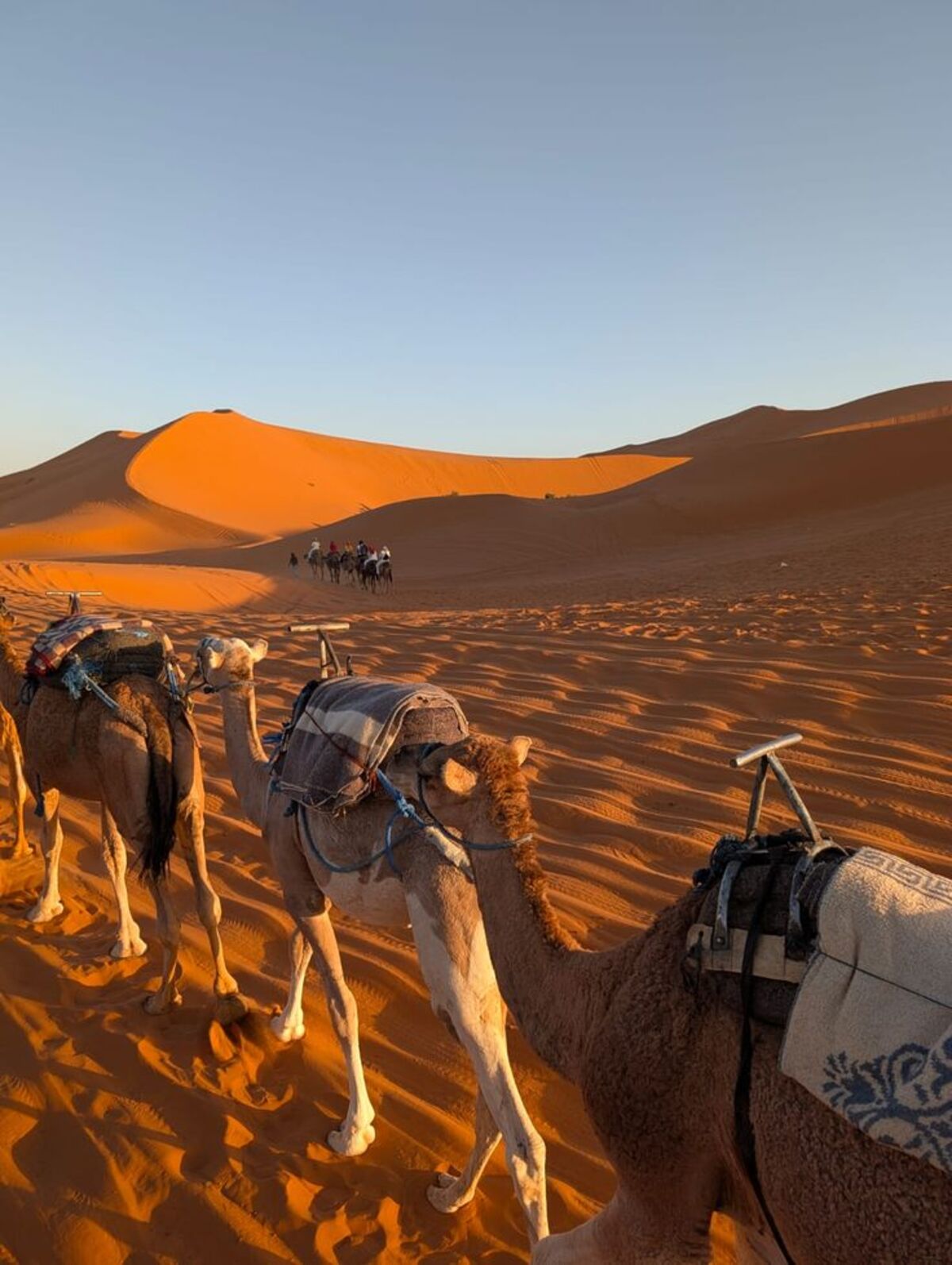
Your camel guide leads the caravan into the dunes. Camels walk at approximately 4 to 5 kilometres per hour in sand. The guide walks alongside or leads from the front camel. There is no rushing the pace is determined by the camels and the terrain.
The light during the camel trek is extraordinary. As the sun descends toward the horizon it turns the sand from gold to deep orange to purple. The shadows lengthen across the dune faces and the colours change every few minutes. Your guide will stop at the best viewpoints for photography.
Arrival at Desert Camp:
After one to one and a half hours of trekking you arrive at the desert camp. Your guide shows you to your tent either a traditional Berber tent with mattresses on the floor or a more comfortable ensuite tent depending on the camp standard you have booked.
Welcome mint tea and dates are served the traditional Moroccan greeting. You have time to explore the camp, climb a nearby dune for views, or simply rest before dinner.
Dinner and Evening:
Dinner at the desert camp is typically served around 8:00 to 9:00 PM. A standard camp meal includes a salad plate, harira soup in cooler months, a main tagine of chicken or lamb with vegetables, fresh Moroccan bread, fruit, and unlimited mint tea.
After dinner the campfire begins and your guides play traditional Berber music bendir drums and Gnawa instruments as the fire burns and the stars emerge overhead. The music is genuine, not performed for tourists, and the atmosphere around the campfire is one of the highlights of the entire Morocco experience for most travellers.
The Night Sky:
The Erg Chebbi desert has zero light pollution for hundreds of kilometres in every direction. On a clear moonless night the Milky Way is fully visible from horizon to horizon. Shooting stars are common. Many travellers describe the desert night sky as the single most impressive natural sight they have ever witnessed.
Even in summer desert nights cool significantly after sunset. In winter months temperatures drop to 2 to 5 degrees Celsius. All camps provide blankets — luxury camps provide duvets and additional layers.
Sunrise:
Your guide wakes you approximately 45 minutes before sunrise typically between 5:30 and 6:30 AM depending on the season. A short camel ride or walk takes you to a high dune position for the sunrise.
The Saharan sunrise is one of the most spectacular natural phenomena on earth. The light moves through deep purple, crimson, orange, and gold over approximately 25 minutes as it catches the dunes and transforms the landscape completely. Most travellers consider this the single best moment of their entire Morocco trip.
Breakfast is served after sunrise at camp bread, olive oil, jam, honey, eggs, and mint tea. Return to Merzouga is either by camel for the same one to one and a half hour journey or by 4×4 vehicle in 15 to 20 minutes.
Morocco Camel Trek Prices What to Expect in 2026
Morocco camel trek prices vary significantly depending on the duration, the number of people in your group, and the quality of the desert camp.
For a short sunset camel ride lasting one to two hours expect to pay 150 to 300 MAD per person approximately 14 to 28 euros. This does not include a desert camp overnight stay.
For a standard overnight Morocco camel trek including the camel ride and a night at a desert camp with dinner and breakfast expect to pay 600 to 1,200 MAD per person approximately 55 to 110 euros. This is the most common option for travellers on an organised Morocco desert tour from Marrakech.
For a luxury overnight camel trek with a premium ensuite desert camp private tent with en-suite bathroom, hot shower, and a multi-course dinner prices range from 1,200 to 2,500 MAD per person approximately 110 to 230 euros.
For a multi-day camel trek of 2 to 4 nights prices range from 1,500 to 4,000 MAD per person depending on duration and camp quality.
Best Time for a Morocco Camel Trek:
The best time for a Morocco camel trek is between October and April when temperatures are comfortable for both the trek and the overnight desert experience.
October and November offer warm days around 28 to 30 degrees Celsius, cool nights, and excellent light for photography. The dunes are at their most golden in autumn light.
March and April are considered the best months by most experienced Morocco travellers. Daytime temperatures reach 23 to 27 degrees Celsius, nights are cool but not cold, and the desert light is exceptional for photography.
December and January are cold desert nights drop to 2 to 5 degrees Celsius but the winter sky is the clearest of the year and the Milky Way is extraordinary. Tourist numbers are lower meaning a more authentic experience with fewer other travellers.
July and August are the hottest months with temperatures reaching 43 to 44 degrees Celsius during the day. Morocco camel treks during these months operate only at dawn and after sunset. The heat is extreme and most international travellers avoid the Sahara in peak summer.
What to Wear on a Morocco Camel Trek:
Packing correctly for a Morocco camel trek is straightforward once you understand the temperature challenge. Days are warm but nights drop sharply even in summer.
For the daytime camel trek wear lightweight breathable clothing with long sleeves to protect your arms from the sun. A large scarf or traditional Moroccan shesh is essential for wrapping around your face if the wind picks up and for protecting your head from the sun during the trek.
For the evening and night bring a warm fleece or jacket regardless of the season. Temperatures drop significantly after sunset in the desert. In October through March bring a proper warm jacket a down jacket is ideal for December through February visits.
Closed-toe shoes or light hiking shoes are recommended for the camel trek and the dune climbs. Sand gets into open shoes quickly on the steep dune faces.
Choosing an Ethical Morocco Camel Trek Operator:
Camels in the Merzouga area vary considerably in how well they are treated. Some operators run their camels multiple times per day without adequate rest, food, or water. Choosing an ethical operator supports animal welfare and a more authentic experience.
Signs of a well-run Morocco camel trek operation include camels in good body condition not thin with visible ribs saddles that are properly padded with no raw sores on the animals’ backs, and camel guides who move at the animal’s pace rather than forcing speed.
Before booking ask how many treks each camel completes per day and what the animals eat between treks. A responsible operator welcomes these questions.
Also confirm the operator is licensed by the Moroccan Ministry of Tourism. Licensed operators follow regulated standards for vehicle safety, guide qualifications, and camp conditions. Unlicensed operators sometimes offer lower prices but have no regulatory accountability.
Frequently Asked Questions:
Is a Morocco camel trek suitable for children?
Yes for children aged 6 and above. Younger children can ride with an adult. The overnight camel trek is particularly well-suited for families children typically find the desert camp, the campfire, and the stars magical.
Will I be sore after a camel trek?
Many first time riders experience mild soreness in the inner thighs and lower back after the one to one and a half hour camel ride. This is normal and manageable. For multi-day treks your body adapts after the first day.
Can elderly travellers do a Morocco camel trek?
The mounting and dismounting process can be physically challenging for older travellers or those with mobility issues. A 4×4 vehicle transfer directly to the desert camp is always available as an alternative delivering the same camp experience without the physical demands of the camel ride.
What happens if there is a sandstorm during the camel trek?
Sandstorms in Erg Chebbi are relatively rare but do occur, particularly in spring. Your camel guide will wrap your face in a scarf and lead you to shelter immediately. Desert camps are designed to withstand strong wind. Follow your guide’s instructions and remain calm.
How many people are typically on a Morocco camel trek?
This depends entirely on your booking. A shared group camel trek typically has 4 to 12 people. A private camel trek is exclusively for your group. Private treks are significantly more personal and allow you to move at your own pace and stop wherever you want for photography.
Do I need experience with camels before a Morocco camel trek?
No experience is necessary. Your camel guide handles all aspects of the trek mounting, dismounting, navigation, and photography stops. The vast majority of people on a Morocco camel trek have never ridden a camel before.
Book Your Morocco Camel Trek
Morocco Desert Guide offers private and shared Morocco camel treks as part of our desert tour packages from Marrakech and Fes. Every camel trek we offer includes licensed experienced camel guides, well-rested and properly maintained camels, desert camp accommodation with dinner and breakfast, and return transfer to Merzouga village.
For more detailed information about desert camps near Merzouga and camel trekking in Erg Chebbi visit our complete destination guides on the Morocco Desert Guide website.


